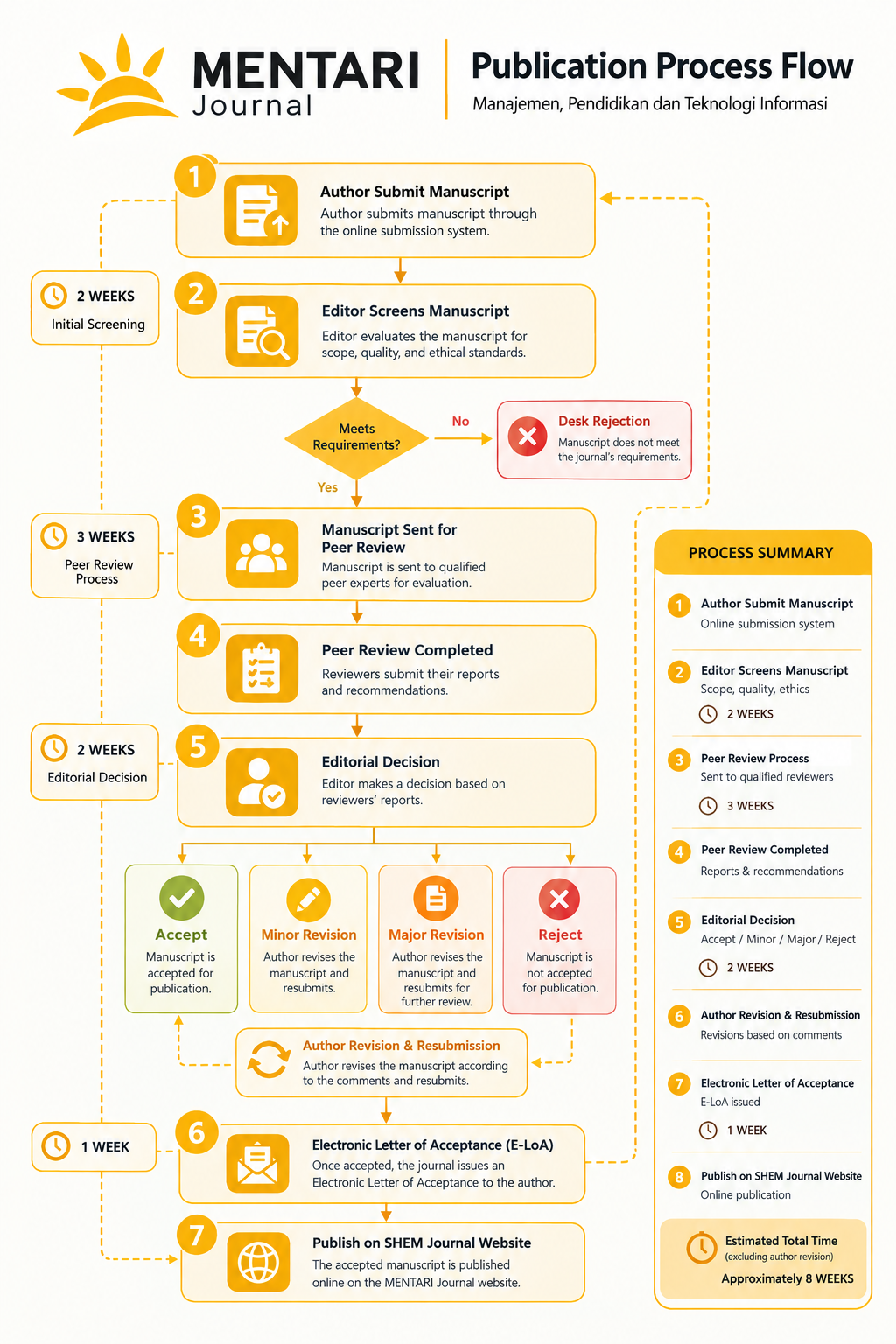
Process Peer Review
Peer Review Process
Jurnal MENTARI applies a rigorous double-blind peer review process to ensure the quality, originality, academic integrity, and scholarly relevance of all manuscripts submitted for publication. The journal publishes research in management, education, and information technology, particularly in the areas of AI-enhanced educational management, vocational education and digital skills, blockchain-based academic data governance, innovative technologies in preschool education, and adaptive e-learning.
All submitted manuscripts undergo an initial editorial assessment, plagiarism screening, and independent peer review. The identities of authors and reviewers are kept confidential throughout the double-blind review process. Editorial decisions are based on the manuscript's originality, methodological rigor, theoretical contribution, relevance to the journal's scope, and compliance with publication ethics.
Step 1 Initial Screening
Estimated time: 1 week
Upon submission, the Editorial Team checks whether the manuscript meets the journal's basic submission requirements. This screening covers the completeness of the manuscript, conformity with the journal template and author guidelines, relevance to the journal's focus and scope, originality, and basic academic quality.
Manuscripts that do not meet the requirements may be returned to the authors for correction or rejected before proceeding to the next stage.
Step 2 Editorial Assessment and Plagiarism Screening
Estimated time: 1 week
The Editor evaluates the manuscript's suitability for publication and determines whether it is appropriate for external peer review. The assessment considers the research objectives, academic contribution, theoretical foundation, methodological appropriateness, clarity of presentation, and relevance to MENTARI Journal.
Manuscripts that pass the editorial assessment undergo plagiarism screening. MENTARI Journal requires manuscripts to meet its similarity threshold of less than 20%. Manuscripts that exceed the permitted threshold or present concerns regarding originality may be returned for improvement or rejected in accordance with the journal's editorial policies.
Passing the plagiarism screening does not guarantee acceptance or publication.
Step 3 Double-Blind Peer Review
Estimated time: Up to 14 working days
Manuscripts that pass the editorial assessment and plagiarism screening are sent to two independent reviewers with expertise relevant to the manuscript's subject. MENTARI Journal applies a double-blind review system, in which reviewers do not know the identities of the authors, and authors do not know the identities of the reviewers.
Reviewers evaluate the manuscript based on the following criteria:
-
Originality and significance of the research contribution.
-
Relevance to the focus and scope of MENTARI Journal.
-
Adequacy of the theoretical foundation and literature review.
-
Appropriateness of the research design and methodology.
-
Validity and clarity of the results and their interpretation.
-
Quality of the discussion and conclusions.
-
Relevance of the findings to educational management, learning innovation, or information technology, as applicable.
-
Compliance with academic integrity and publication ethics.
-
Clarity of writing, organization, and presentation.
Reviewers provide constructive comments and recommendations to help the Editor determine the manuscript's suitability for publication. Reviewers must maintain confidentiality, disclose potential conflicts of interest, and conduct their evaluations objectively.
The review period may be extended when additional assessment is necessary or reviewer availability affects the process.
Step 4 Author Revision
Revision deadline: Within 7 days after the review results are sent
Based on the reviewers' recommendations, the Editor may request minor revisions or major revisions. Authors must carefully address the reviewers' comments and submit a revised manuscript within the specified deadline.
Authors are expected to provide a point-by-point response explaining how each comment has been addressed. If a suggestion is not adopted, the authors should provide a clear academic justification.
Revised manuscripts may be returned to the original reviewers for further evaluation when necessary. Failure to submit the revision within the specified deadline may result in rejection, subject to the journal's editorial policies.
Step 5 Final Editorial Decision
After evaluating the reviewers' reports and the authors' revisions, the Editor makes the final editorial decision. The possible decisions are:
-
Accept: The manuscript meets the journal's requirements and is accepted for publication.
-
Minor Revision: The manuscript requires limited corrections before a final decision can be made.
-
Major Revision: Substantial improvements are required, and the revised manuscript may undergo further review.
-
Reject: The manuscript does not meet the journal's standards or is unsuitable for publication.
The final decision rests with the Editor and is based on the overall quality of the manuscript, the reviewers' recommendations, the adequacy of revisions, and compliance with the journal's editorial standards. Acceptance is not guaranteed solely by completing the review process.
Step 6 Copyediting, Proofreading, and Publication
Estimated time: 1–2 weeks
Accepted manuscripts proceed to the production stage, which includes copyediting, formatting, typesetting, proofreading, and final editorial checks. Authors may be asked to review the proof and confirm the accuracy of the final version before publication. The completed article is published online according to the journal's publication schedule. MENTARI Journal publishes two issues per year, in March and September.
Estimated Review and Publication Timeline
| Stage | Estimated Time |
|---|---|
| Initial Screening | 1 week |
| Editorial Assessment and Plagiarism Screening | 1 week |
| Double-Blind Peer Review | Up to 14 working days |
| Author Revision | Within 7 days |
| Final Editorial Decision | Approximately 1 week |
| Copyediting and Publication Preparation | 1–2 weeks |
The estimated timeline is indicative and may vary depending on reviewer availability, the extent of revisions required, the number of review rounds, and the time needed to complete editorial and production procedures.
Confidentiality and Publication Ethics
MENTARI Journal is committed to maintaining confidentiality, fairness, objectivity, and academic integrity throughout the peer review process. Editors and reviewers must protect unpublished manuscript content and avoid conflicts of interest that could compromise their assessments. Reviewers are expected to provide constructive, evidence-based feedback, while authors are responsible for the originality, accuracy, and integrity of their submissions. All editorial decisions are made independently and without discrimination based on the authors' institutional affiliation, nationality, gender, or personal background.
The journal reserves the right to reject manuscripts that fail to meet its academic, ethical, or editorial requirements at any stage of the publication process.