Peer Review Process
SABDA applies a structured double-blind peer review process to ensure the quality, originality, academic integrity, and relevance of every manuscript. The review process normally takes approximately 6–12 weeks, excluding delays caused by author revisions, reviewer availability, or other unforeseen circumstances.
Step 1 — Initial Screening
Estimated time: 1 week
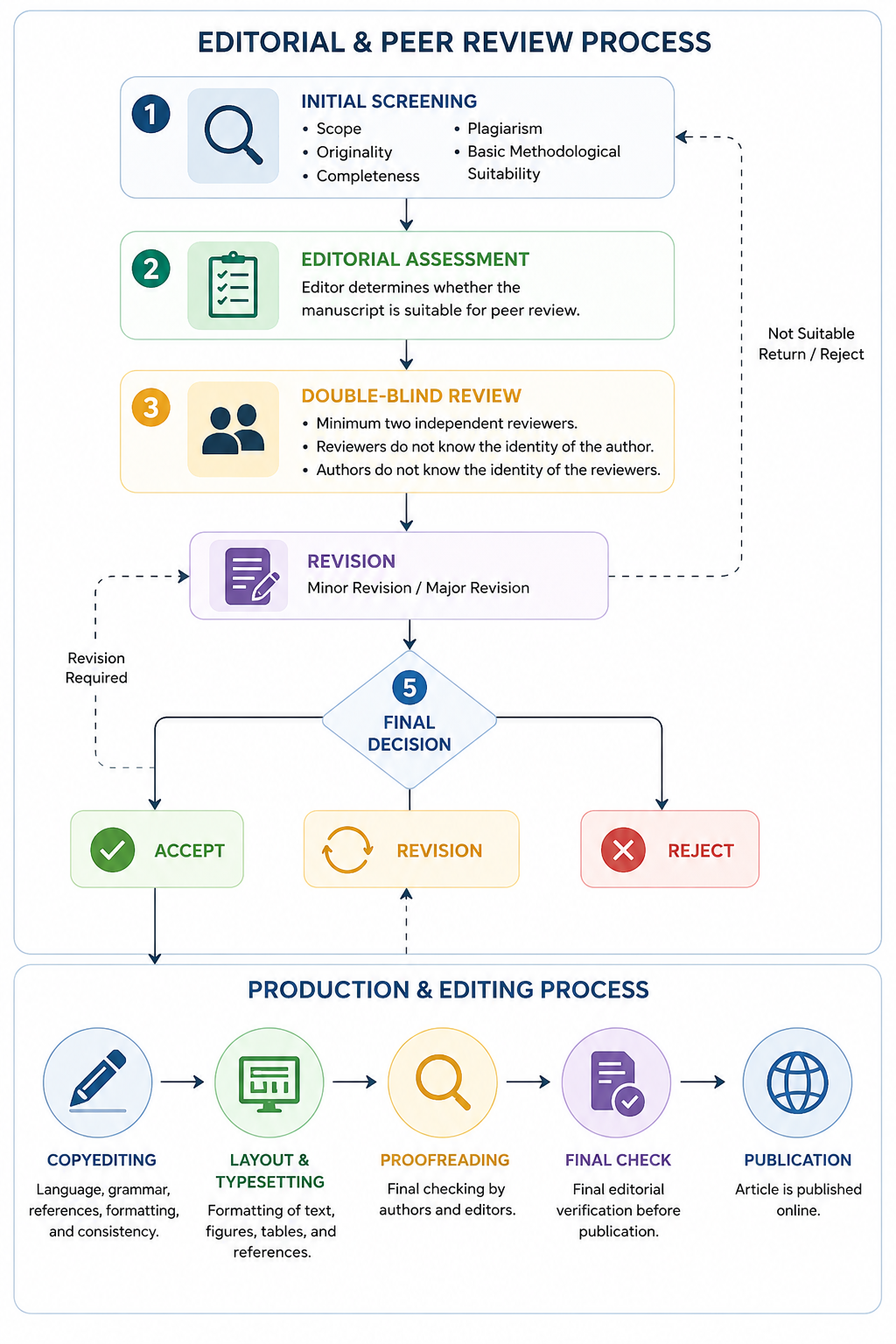
After submission, the Editorial Team conducts an initial screening to assess the manuscript's scope, originality, completeness, plagiarism or similarity, and basic methodological suitability. Manuscripts that do not meet the journal's basic requirements may be returned to the authors for correction or rejected at this stage.
Step 2 — Editorial Assessment
Estimated time: 1 week
Following the initial screening, the Editor evaluates whether the manuscript is suitable for external peer review. The assessment considers the manuscript's relevance to the journal's scope, academic contribution, research objectives, methodological appropriateness, and overall scholarly quality. Manuscripts that pass this stage are assigned to qualified reviewers.
Step 3 — Double-Blind Peer Review
Estimated time: 2–4 weeks
Manuscripts that pass the editorial assessment are sent to at least two independent reviewers with relevant expertise. SABDA applies a double-blind review system in which reviewers do not know the identity of the authors, and authors do not know the identity of the reviewers. Reviewers evaluate the manuscript's originality, theoretical foundation, methodology, results, discussion, contribution, and overall academic quality.
If reviewers are unavailable or additional expertise is required, the review period may be extended.
Step 4 — Revision
Estimated time: 2–4 weeks for authors
Based on the reviewers' recommendations, the Editor may request Minor Revision or Major Revision. Authors are expected to revise the manuscript carefully and provide a clear response to each reviewer comment. The revision period may vary depending on the extent of the required changes.
When necessary, the revised manuscript may be returned to the reviewers for further evaluation. Additional review rounds may therefore extend the overall publication timeline.
Step 5 — Final Editorial Decision
Estimated time: 1 week
After receiving the revised manuscript and, when applicable, the reviewers' further recommendations, the Editor makes the final editorial decision. The possible decisions are Accept, Revision, or Reject. The final decision is based on the overall academic quality of the manuscript, the adequacy of the revisions, and the reviewers' evaluations.
Step 6 — Production and Editing
Estimated time: 1–2 weeks
Accepted manuscripts proceed to the production stage. The process includes copyediting, layout and typesetting, proofreading, final editorial checking, and publication. Authors may be asked to review the final proof and confirm any necessary corrections before the article is published online.
Estimated Timeline
| Stage | Estimated Time |
|---|---|
| Initial Screening | 1 week |
| Editorial Assessment | 1 week |
| Double-Blind Peer Review | 2–4 weeks |
| Author Revision | 2–4 weeks |
| Final Editorial Decision | 1 week |
| Production & Editing | 1–2 weeks |
Estimated editorial and publication process: approximately 8–13 weeks, depending on the number of review rounds, reviewer availability, and the time required by authors to complete revisions.
The stated timelines are estimates rather than guaranteed deadlines. SABDA may extend the review period when additional reviewers are required, reviewers need to be replaced, substantial revisions are necessary, or other circumstances affect the editorial process.
Editorial and Editing Process