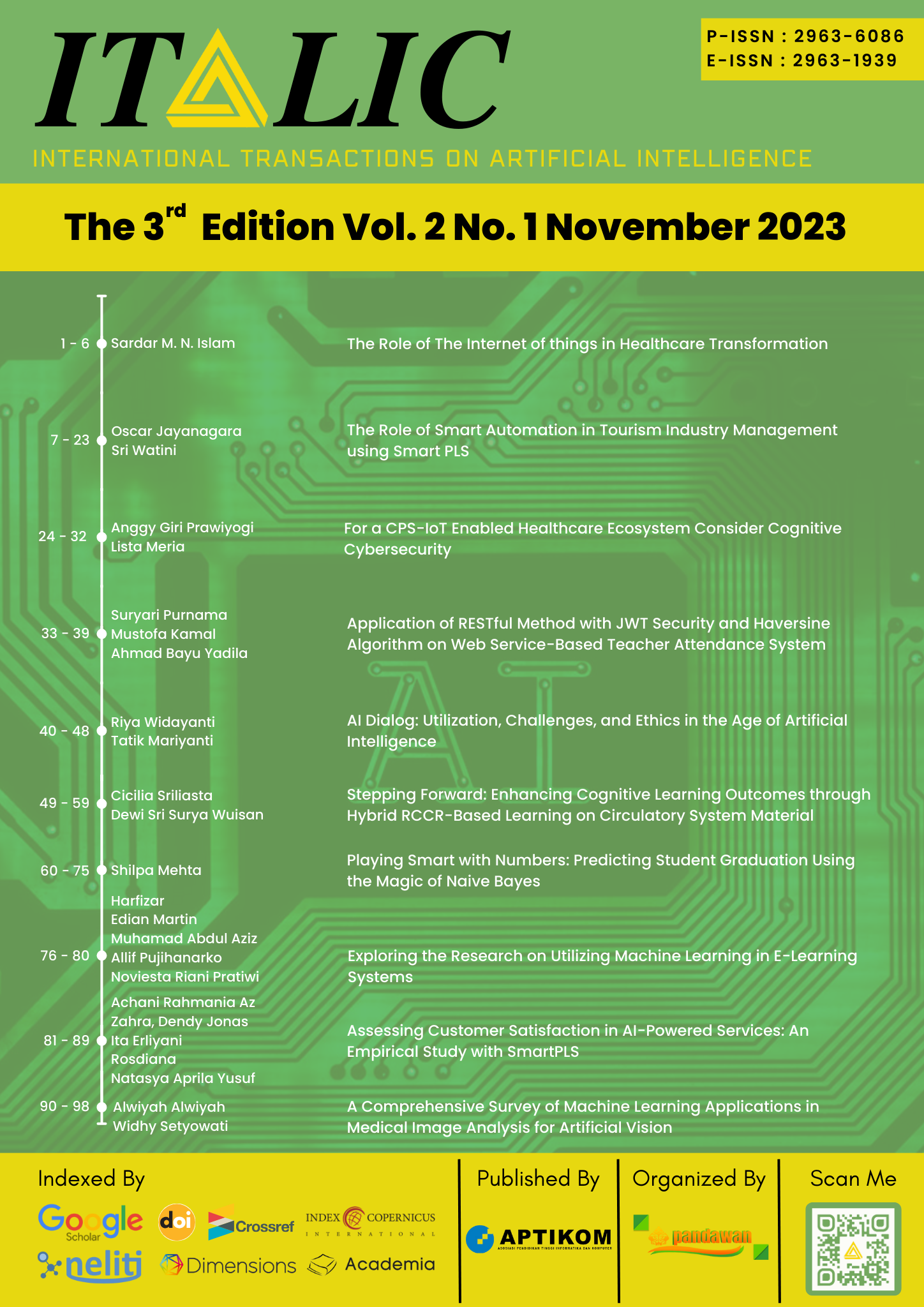
AI Dialog: Utilization, Challenges, and Ethics in the Age of Artificial Intelligence
DOI:
https://doi.org/10.33050/italic.v2i1.401Keywords:
Artificial Intelligence , Utilization , Challenges , Ethical Aspects in Usage , Dialog SystemsAbstract
In this writing, we will delve into every aspect of the utilization, challenges, as well as ethical considerations in harnessing Artificial Intelligence (AI) Technology, with a focus on ChatGPT, an exceptional language model. AI technology has become an inseparable element in modern life, manifesting across various sectors such as business, healthcare, governance, and several others. The capabilities of AI are capable of driving data-driven decision-making, reducing the potential for human errors, and enhancing process efficiency. However, its impact is also not devoid of potential risks, including data security and the replacement of human roles. To ensure intelligent AI usage, it is imperative to uphold AI ethics, protect user information and privacy, strive to prevent discriminatory practices, and ensure system safety stability. The questions raised in this study revolve around the benefits and challenges of implementing ChatGPT, optimizing its use, and its role in the realm of education. The mission of this study is to unravel the benefits, challenges, as well as ethical considerations in the utilization of ChatGPT in the AI era, while ensuring responsible steps in its application.
References
Y. K. Dwivedi et al., “Artificial Intelligence (AI): Multidisciplinary perspectives on emerging challenges, opportunities, and agenda for research, practice and policy,” International Journal of Information Management, vol. 57, p. 101994, 2021. doi:10.1016/j.ijinfomgt.2019.08.002
A. Haleem, M. Javaid, and R. P. Singh, “An era of CHATGPT as a significant futuristic support tool: A study on features, abilities, and challenges,” BenchCouncil Transactions on Benchmarks, Standards and Evaluations, vol. 2, no. 4, p. 100089, 2022. doi:10.1016/j.tbench.2023.100089
A. Sai Ramesh et al., “Artificial Intelligence Driven Hydrogen and Battery Technologies – A Review,” Fuel, vol. 337, p. 126862, 2023. doi:10.1016/j.fuel.2022.126862
M. Ali and M. K. Abdel-Haq, “Bibliographical Analysis of Artificial Intelligence Learning in higher education,” Fostering Communication and Learning With Underutilized Technologies in Higher Education, pp. 36–52, 2021. doi:10.4018/978-1-7998-4846-2.ch003
M. Firat, How chat GPT can transform autodidactic experiences and open education?, 2023. doi:10.31219/osf.io/9ge8m
J. M. White and R. Lidskog, “Ignorance and the regulation of Artificial Intelligence,” Journal of Risk Research, vol. 25, no. 4, pp. 488–500, 2021. doi:10.1080/13669877.2021.1957985
Sriliasta, C., Wuisan, D. S. S., & Mariyanti, T. (2022). Functions of Artificial Intelligence, Income Investment Instrument, and Crypto Money in Era of The Fourth Revolution. International Transactions on Artificial Intelligence, 1(1), 117-128.
Sunarya, P. A. (2022). Machine Learning and Artificial Intelligence as Educational Games. International Transactions on Artificial Intelligence, 1(1), 129-138.
M. Favaretto, E. De Clercq, J. Gaab, and B. S. Elger, “First do no harm: An exploration of researchers’ ethics of conduct in Big Data Behavioral Studies,” PLOS ONE, vol. 15, no. 11, 2020. doi:10.1371/journal.pone.0241865
Chu, M. et al. (2023) ‘Work with AI and work for AI: Autonomous Vehicle Safety Drivers’ lived experiences’, Proceedings of the 2023 CHI Conference on Human Factors in Computing Systems [Preprint]. doi:10.1145/3544548.3581564.
Bist, A.S. et al. (2022) ‘Managing digital transformation in marketing: “Fusion of traditional marketing and digital marketing”’, International Transactions on Artificial Intelligence (ITALIC), 1(1), pp. 18–27. doi:10.34306/italic.v1i1.86.
Teja Sukmana, H., Emmanuel Widjaja, A. and Situmorang, H.J. (2022) ‘Game theoretical-based Logistics Costs Analysis: A Review’, International Transactions on Artificial Intelligence (ITALIC), 1(1), pp. 43–61. doi:10.33050/italic.v1i1.166.
Subrata, T. et al. (2022) ‘Implementation of the tableau application to determine earthquake prone areas with geolocation features’, 2022 IEEE Creative Communication and Innovative Technology (ICCIT) [Preprint]. doi:10.1109/iccit55355.2022.10119061.
Tarek, A. (2023) ‘Intellectual property implications of artificial intelligence and ownership of AI-generated works’, SSRN Electronic Journal [Preprint]. doi:10.2139/ssrn.4494640.
Guida, M. et al. (2023) ‘The role of Artificial Intelligence in the procurement process: State of the art and research agenda’, Journal of Purchasing and Supply Management, 29(2), p. 100823. doi:10.1016/j.pursup.2023.100823.
Krause, D. (2023) ‘Mitigating risks for financial firms using generative AI Tools’, SSRN Electronic Journal [Preprint]. doi:10.2139/ssrn.4452600.
Aissani, R. et al. (2023) ‘Artificial Intelligence Tools in media and journalism: Roles and concerns’, 2023 International Conference on Multimedia Computing, Networking and Applications (MCNA) [Preprint]. doi:10.1109/mcna59361.2023.10185738.
Sriliasta, C., Surya Wuisan, D.S. and Mariyanti, T. (2022) ‘Functions of artificial intelligence, income investment instrument, and crypto money in ERA of the Fourth Revolution (italic)’, International Transactions on Artificial Intelligence (ITALIC), 1(1), pp. 117–128. doi:10.34306/italic.v1i1.205.
F. Saeik et al., “Task offloading in Edge and Cloud Computing: A survey on
mathematical, artificial intelligence and control theory solutions,” Comput. Networks,
vol. 195, p. 108177, 2021.
D. Papatsaroucha, Y. Nikoloudakis, I. Kefaloukos, E. Pallis, and E. K. Markakis, “A
survey on human and personality vulnerability assessment in cyber-security:
Challenges, approaches, and open issues,” arXiv Prepr. arXiv2106.09986, 2021.
Mariyanti, T. (2023). Development of Mobile Learning Applications for Android Based
on Artificial Intelligence. International Transactions on Artificial Intelligence, 1(2),
-235.
Meria, L. (2023). Development of Automatic Industrial Waste Detection System for
Leather Products using Artificial Intelligence. International Transactions on Artificial
Intelligence, 1(2), 195-204.
Sriliasta, C., & Meilinda, V. (2023). Overview of Life Cycle Assessment of Current
Emerging Technologies. International Transactions on Artificial Intelligence, 1(2),
-181.
Jayanagara, O., & Wuisan, D. S. S. (2023). An Overview of Concepts, Applications,
Difficulties, Unresolved Issues in Fog Computing and Machine Learning. International
Transactions on Artificial Intelligence, 1(2), 213-229.
Hudiono, R. K., & Watini, S. (2023). Remote Medical Applications of Artificial
Intelligence. International Transactions on Artificial Intelligence, 1(2), 182-187.
Downloads
Published
Issue
Section
License
Copyright (c) 2023 Riya Widayanti

This work is licensed under a Creative Commons Attribution 4.0 International License.