PEER REVIEW PROCESS

PEER REVIEW PROCESS

AL-WAARITS implements a rigorous Double-Blind Peer Review system to ensure the quality, originality, relevance, and academic integrity of every published article. Under this system, the identities of authors and reviewers remain confidential throughout the review process.

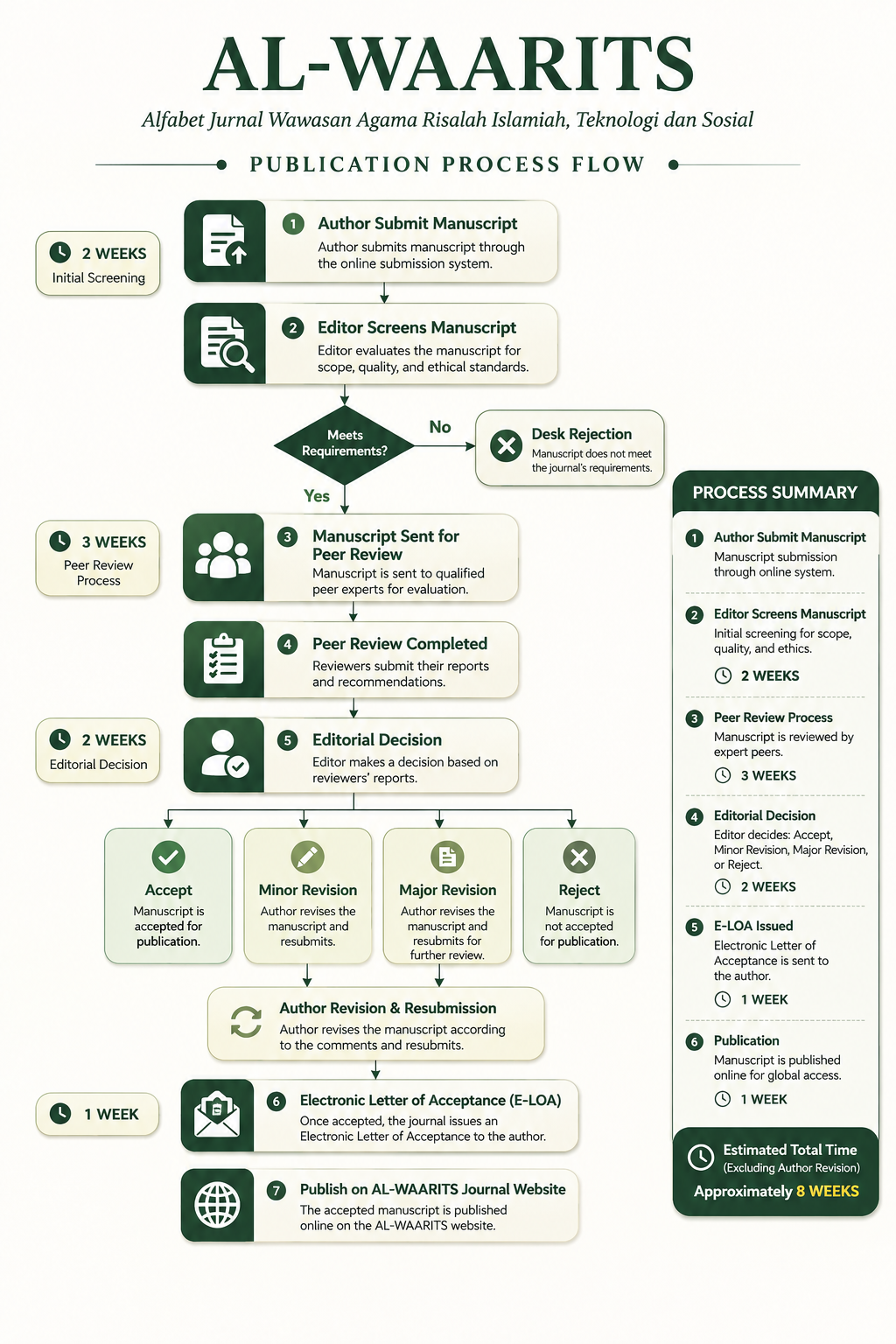
All submitted manuscripts undergo an initial editorial screening to assess their suitability for the journal's focus and scope, compliance with the author guidelines, manuscript completeness, writing quality, and publication ethics standards. Manuscripts that do not meet the initial requirements may be returned to the authors for improvement or rejected by the editor.

Manuscripts that pass the initial screening are assigned to at least three independent reviewers with relevant expertise in the subject area. Reviewers evaluate the originality, academic contribution, topic relevance, methodological appropriateness, accuracy of the discussion, and clarity of the manuscript.

Upon completion of the review process, the editorial team considers the reviewers' evaluations and recommendations before making an editorial decision. Authors may be required to revise their manuscripts in accordance with the reviewers' comments and suggestions. Revised manuscripts are subsequently evaluated before a final decision is issued.

AL-WAARITS Peer Review Process
✓ Peer Review Stages
1

Initial Editorial Screening

The editor examines the manuscript's suitability for the journal's focus and scope, compliance with the author guidelines, document completeness, and publication ethics standards.

2

Reviewer Assignment

Manuscripts that pass the initial screening are assigned to at least three independent reviewers with relevant expertise.

3

Double-Blind Peer Review

Reviewers evaluate the manuscript's academic quality and suitability without knowing the authors' identities. Likewise, reviewers' identities are not disclosed to the authors.

4

Review Reports and Recommendations

Reviewers submit their comments, suggestions for improvement, and recommendations to the editor for consideration in the editorial decision-making process.

5

Editorial Decision

Based on the review results, the editor makes one of the following decisions:

Accepted The manuscript is accepted without substantial revisions.
Minor Revision The manuscript requires minor corrections or improvements.
Major Revision The manuscript requires substantial revisions and may undergo further review.
Rejected The manuscript is rejected because it does not meet the journal's standards or requirements.
6

Author Revision and Resubmission

Authors revise their manuscripts based on the reviewers' comments and recommendations and resubmit the revised versions through the journal's submission system.

7

Final Editorial Assessment and Acceptance

The editor evaluates the revised manuscript to ensure that the required improvements have been addressed. Manuscripts that meet the journal's requirements receive a final acceptance decision and an Electronic Letter of Acceptance (E-LOA).

8

Copyediting and Publication

Accepted manuscripts proceed to final copyediting, formatting, and publication preparation in accordance with the journal's publication schedule.

◷ Estimated Editorial Timeline
Stage Estimated Duration
Initial Editorial Screening 2 weeks
Peer Review Process 3 weeks
Editorial Decision 2 weeks
E-LOA and Final Publication Preparation 1 week
Total Estimated Duration 8 weeks

Note: The estimated timeline represents the editorial process and excludes the time required for authors to complete revisions. The actual duration may vary depending on reviewer availability, manuscript complexity, the number of revision rounds, and the time taken by authors to submit their revisions. The final publication date is also subject to the AL-WAARITS publication schedule.