Editorial Policies
|
EDITORIAL POLICIES International Transactions on Education Technology (ITEE) The policies that govern submission, review, publication, and access at ITEE, in line with the COPE Core Practices and the DOAJ criteria. |
1. Focus and Scope
|
FOCUS Educational technology within the learning factory concept, where theoretical learning is integrated with practical and industrial applications. |
International Transactions on Education Technology (ITEE) publishes original research articles and review articles that examine how technology can improve teaching, learning, and the management of education. The journal gives particular attention to studies conducted in or applicable to learning factory settings, and welcomes empirical, design and development, and review studies. ITEE accepts manuscripts in the following five areas.
| 1 |
AI-Driven Learning Factory The application of artificial intelligence to create adaptive learning environments within learning factories. Topics include: adaptive learning systems, intelligent tutoring systems, learning analytics, AI-based assessment and feedback, and personalised learning paths. |
| 2 |
Data Science in the Learning Factory Context The use of data science to analyse and improve learning outcomes, with results that are academically rigorous and applicable to educational practice. Topics include: educational data mining, prediction of student performance, data-driven decision making in education, learning outcome measurement, and visualisation of educational data. |
| 3 |
Enhanced Learning Technologies The use of immersive and wearable technologies to support hands-on, outcome-based learning. Topics include: virtual reality, augmented and mixed reality, simulation and digital twins for learning, wearable devices, gamification, and the Internet of Things in learning environments. |
| 4 |
Educational Information Systems The design, development, and evaluation of information systems and platforms that support learning and the management of educational institutions and learning factories. Topics include: learning management systems, e-learning and mobile learning platforms, academic information systems, digital campus and smart campus systems, and system usability and adoption in education. |
| 5 |
Interdisciplinary Learning Factory Projects Research that combines several disciplines within the learning factory framework to produce new educational solutions and practices. Topics include: project-based and work-based learning, industry and university collaboration, entrepreneurship and innovation skills in education, sustainability in technology-enhanced learning, and curriculum design for learning factories. |
|
Article Types Accepted ✔ Original research articles: empirical, experimental, design, and development studies. ✔ Review articles: systematic literature reviews, bibliometric analyses, and critical reviews that offer a clear synthesis. |
Outside the Scope Manuscripts in which technology or education is not the main subject of the study are not considered, for example studies that focus only on clinical health, general business management, or technical systems without an educational purpose or evaluation. Manuscripts outside the scope are returned to the authors at the initial screening stage, without external review. |
|
Journal Mission ITEE aims to serve as a platform for the exchange of research that advances knowledge in educational technology and supports the development of quality education systems, in line with Sustainable Development Goal 4 (Quality Education). Authors who are unsure whether their manuscript fits the scope of the journal may contact the editorial office at itee@pandawan.id before submission. |
2. Section Policies
ITEE publishes original research articles and review articles in a single section.
| Section | Open Submissions | Indexed | Peer Reviewed |
| Articles | ✔ | ✔ | ✔ |
3. Peer Review Process
| Double-blind Review model |
≥ 3 reviewers Per manuscript |
± 7 weeks Submission to decision |
± 8 weeks Submission to publication* |
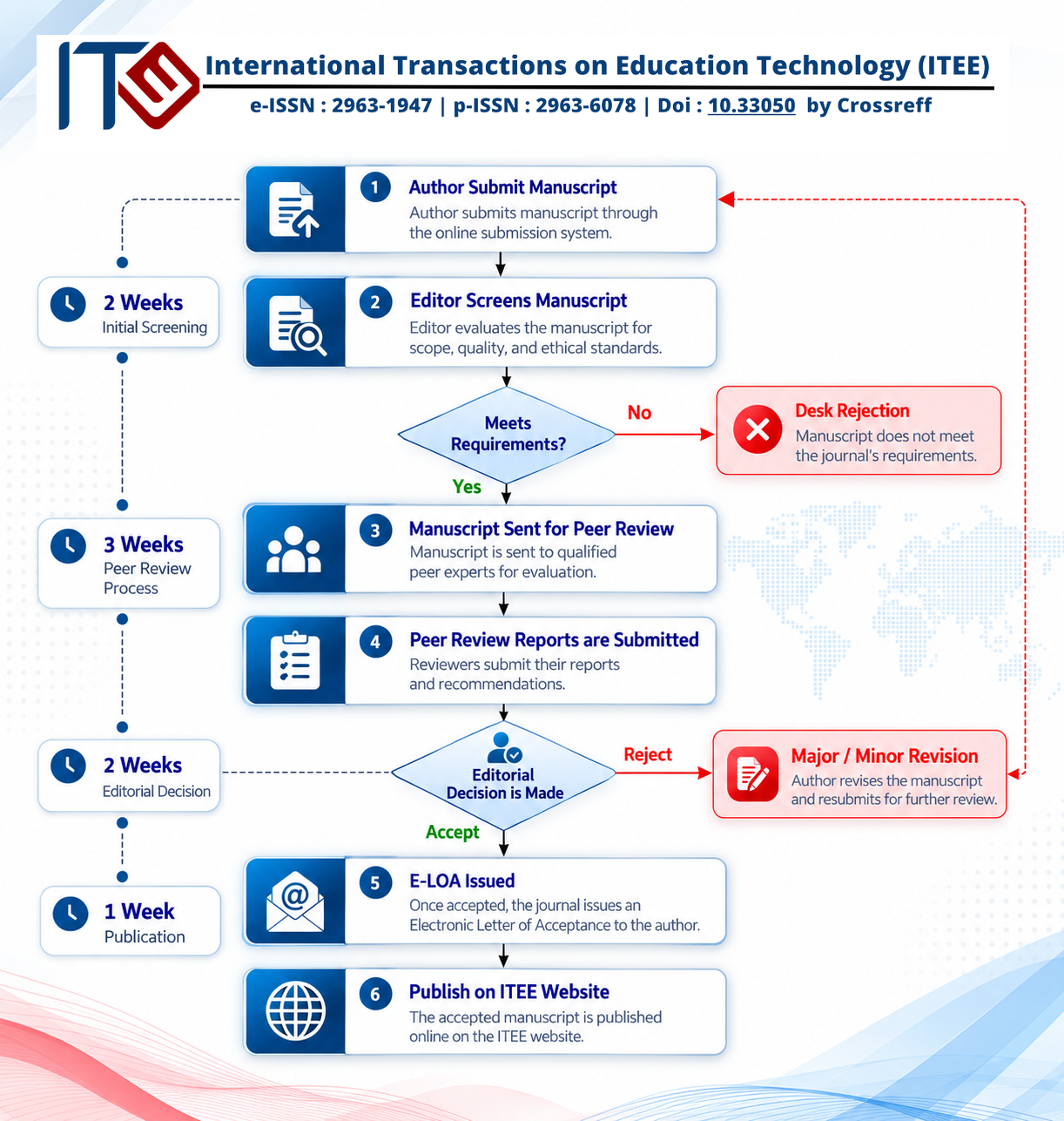
International Transactions on Education Technology (ITEE) applies a double-blind peer review process, in which the identities of authors and reviewers are not disclosed to each other. All submissions and reviews are managed through the journal's Open Journal Systems (OJS). Each manuscript is evaluated by at least three (3) reviewers with expertise relevant to its subject. The review workflow is shown in the diagram below.
Review Workflow
| 1 |
Author Submits Manuscript The author submits the manuscript through the ITEE online submission system, prepared according to the author guidelines and the journal template, with all identifying information removed from the manuscript file. |
| 2 |
Editor Screens Manuscript · within 2 weeks The Editor evaluates the manuscript for its suitability with the focus and scope of the journal, its quality, and its compliance with ethical standards, including a similarity check using Turnitin. Manuscripts that do not meet these requirements receive a desk rejection and are not sent for external review. |
| 3 |
Manuscript Sent for Peer Review Manuscripts that meet the requirements are sent to at least three (3) reviewers with relevant expertise. Reviewers are not appointed from the same institution as any of the authors and are required to declare any potential conflict of interest before accepting the assignment. |
| 4 |
Peer Review Reports are Submitted · within 3 weeks Reviewers evaluate the manuscript on the basis of originality, scientific contribution, methodology, relevance to the scope of the journal, and clarity of presentation, and submit their reports and recommendations through OJS. |
| ◆ |
Editorial Decision is Made · within 2 weeks Based on the reviewers' recommendations, the Editor decides to accept the manuscript, to request a minor or major revision, or to reject it. When a revision is requested, the author revises the manuscript and resubmits it with a point-by-point response to the reviewers' comments within four (4) weeks. The revised manuscript may be returned to the reviewers for further evaluation. |
| 5 |
E-LOA Issued Once the manuscript is accepted, the journal issues an Electronic Letter of Acceptance (E-LOA) to the corresponding author. |
| 6 |
Publish on ITEE Website · within 1 week The accepted manuscript is copyedited, laid out, and checked by the author through the galley proof, and is then published open access on the ITEE website with a Digital Object Identifier (DOI) as part of the May or November issue. |
|
Review Timeline
* Excluding the time taken by authors to revise the manuscript (up to 4 weeks per revision round). |
Editorial Decisions
|
|
Manuscripts Submitted by Editors and Reviewers Manuscripts submitted by the Editor-in-Chief, members of the editorial board, or reviewers of ITEE are handled by an editor who has no conflict of interest with the submission. The submitting editor is excluded from all stages of the review and decision process, and the manuscript is subject to the same double-blind review as all other submissions. |
Appeals Authors who wish to appeal an editorial decision may submit a written appeal with supporting justification to itee@pandawan.id. Appeals are evaluated by the Editor-in-Chief or a designated editor who was not involved in the original decision. |
|
The final decision on each manuscript rests with the Editor-in-Chief, taking into account the reviewers' recommendations and the editorial policies of the journal. Reviewers may refer to the Reviewer Guidelines for the evaluation criteria. |
4. Publication Frequency
ITEE is published twice a year. Manuscripts may be submitted at any time and are considered for the next available issue after acceptance.
| No. 1 · May First issue of each volume |
No. 2 · November Second issue of each volume |
[6] articles Per issue ([12] per year) |
5. Open Access Statement
ITEE is a fully open access journal. All articles are freely available to read, download, copy, distribute, print, search, and link to the full text immediately upon publication, without embargo and without registration. Readers are not charged for access.
Authors retain the copyright of their articles and retain full publishing rights without restriction. All articles are published under the Creative Commons Attribution 4.0 International License (CC BY 4.0). Further details are provided in the Copyright and License Statement.
|
You are free to: Share — copy and redistribute the material in any medium or format for any purpose, even commercially. Adapt — remix, transform, and build upon the material for any purpose, even commercially. |
Under the following terms: Attribution — appropriate credit must be given to the authors and to the original publication in ITEE, with a link to the license and an indication of any changes. No additional restrictions — no legal terms or technological measures may be applied that restrict others from doing anything the license permits. |
6. Archiving
ITEE preserves its published content to ensure that articles remain permanently accessible.
| No | Service | Description |
| 1 | [PKP Preservation Network (PKP PN)] | Digital preservation service for journals using Open Journal Systems, registered in the Keepers Registry. |
| 2 | LOCKSS LOCKSS Publisher Manifest |
Lots of Copies Keep Stuff Safe (LOCKSS) is an open-source system developed by Stanford University Libraries that allows participating libraries to collect, preserve, and provide access to the journal content. |
| 3 | CLOCKSS CLOCKSS Publisher Manifest |
Controlled LOCKSS (CLOCKSS) is a dark archive maintained by a community of research libraries and publishers. Archived content is made freely available if the journal ceases publication or is no longer accessible online. |
7. Publication Ethics
ITEE follows the COPE Core Practices. This statement sets out the ethical responsibilities of all parties involved in the publication process: the publisher, editors, reviewers, and authors. The use of generative AI is governed by the Generative AI Policy for ITEE Journal.
7.1 Publisher
|
Responsibility. Pandawan Sejahtera Indonesia, as the publisher of ITEE, supports all stages of publication and ensures that advertising, reprint, and other commercial revenue has no influence on editorial decisions. The publisher assists in communication with other journals or publishers where necessary. |
7.2 Duties of Editors
|
Publication decisions. The Editor decides which manuscripts are published, based on the validity of the work and its importance to researchers and readers, and within the legal requirements regarding libel, copyright infringement, and plagiarism. Fair play. Manuscripts are evaluated on their intellectual content without regard to the race, gender, sexual orientation, religious belief, ethnic origin, citizenship, or political views of the authors. Confidentiality. Editors do not disclose information about a submitted manuscript to anyone other than the corresponding author, reviewers, potential reviewers, other editorial advisers, and the publisher, as appropriate. Conflicts of interest. Unpublished material in a submitted manuscript is not used in an editor's own research without the written consent of the author. Editors withdraw from handling manuscripts in which they have a conflict of interest. Citation practice. Editors and reviewers do not require authors to cite articles from ITEE or from other journals of the same publisher. |
7.3 Duties of Reviewers
|
Contribution to editorial decisions. Peer review assists the Editor in making decisions and helps authors improve their manuscripts. Promptness. Reviewers who feel unqualified to review a manuscript, or who cannot complete the review on time, notify the Editor and withdraw from the review. Confidentiality. Manuscripts received for review are treated as confidential documents and are not shown to or discussed with others without the Editor's authorisation. Objectivity. Reviews are conducted objectively and supported by clear arguments. Personal criticism of the authors is not appropriate. Acknowledgement of sources. Reviewers identify relevant published work not cited by the authors and inform the Editor of any substantial similarity with other published work. Conflicts of interest. Reviewers do not review manuscripts in which they have a conflict of interest arising from competitive, collaborative, or other relationships with the authors or institutions involved. |
7.4 Duties of Authors
|
Reporting standards. Authors present an accurate account of the work performed and an objective discussion of its significance, with sufficient detail to allow others to replicate the work. Data access and retention. Authors may be asked to provide the raw data of their study for editorial review and should retain such data for a reasonable time after publication. Originality and plagiarism. Authors ensure that their work is entirely original and that the work or words of others are properly cited or quoted. Multiple or concurrent publication. Authors do not submit the same manuscript to more than one journal at the same time or publish the same research in more than one primary publication. Authorship. Authorship is limited to those who have made a significant contribution to the conception, design, execution, or interpretation of the study. The corresponding author ensures that all co-authors have approved the final version and its submission. Disclosure of conflicts of interest and funding. Authors disclose any financial or other conflict of interest and all sources of financial support for the study. Errors in published works. Authors who discover a significant error in their published work promptly notify the Editor and cooperate in correcting or retracting the article. |
|
7.5 Corrections and Retractions Where an error or a case of misconduct is identified in a published article, ITEE publishes a correction, an expression of concern, or a retraction in accordance with the COPE guidelines. Retracted articles remain available online and are clearly marked as retracted. |
7.6 Complaints Complaints regarding the editorial process or the conduct of the journal may be submitted to itee@pandawan.id. All complaints are acknowledged within five (5) working days and are handled fairly for all parties involved. |
8. Editorial and Editing Process
The stages from submission to acceptance, including the workflow diagram, are described in the Peer Review Process. After acceptance, each manuscript goes through the following editing stages before publication.
| Stage | Description |
| Copyediting | The manuscript is checked for language, consistency, and conformity with the journal style and the IEEE reference format. |
| Layout | The manuscript is typeset according to the ITEE template and assigned a DOI. |
| Proofreading | The galley proof is sent to the corresponding author, who checks and returns it within three (3) working days. Corrections are limited to typographical errors, errors in data, and updated references. |
| Publication | The final version is published open access on the ITEE website within one week after the E-LOA, as part of the May or November issue. |
9. Author Fees
ITEE charges an Article Processing Charge (APC) to support open access publication. The APC is charged only after a manuscript has been accepted, and payment has no influence on the review process or the editorial decision.
| USD 0 Submission fee |
USD 350 APC per accepted article (up to 12 pages) |
USD 50 Per additional page |
| Item | Details |
| Submission fee | None |
| Article Processing Charge | USD 350, covering up to 12 pages in the journal template, regardless of the number of authors |
| Additional pages | USD 50 per page beyond 12 pages |
| Other charges | No colour charges and no fee for withdrawing a manuscript |
| Services covered | Editorial management, peer review administration, similarity check, DOI registration, copyediting, layout, online hosting, and archiving |
| Time of payment | After the official acceptance notification |
10. Indexing
All articles published in ITEE are assigned a Digital Object Identifier (DOI) through Crossref with the prefix 10.33050/itee. ITEE is accredited SINTA 2 and is indexed by the following services:
 |
 |
 |
 |
 |
 |
 |
.png">)  |
11. Screening for Plagiarism
All submitted manuscripts are checked for similarity using Turnitin before peer review and again before publication. The similarity report is reviewed by the Editor and is not used as the only basis for a decision.
| Similarity Index | Action |
| Up to [20]% | The manuscript proceeds to the next stage. |
| Above [20]% | The manuscript is returned to the authors for revision or rejected, depending on the source and extent of the overlap. |
Manuscripts found to contain plagiarism after publication are handled in accordance with the corrections and retractions policy in Section 7.5.